What happened here?
Introduced in 1839, the daguerreotype was the first widely successful photographic process and launched the age of photography.
Learn more about this event
A Glimpse of the World Through Silver
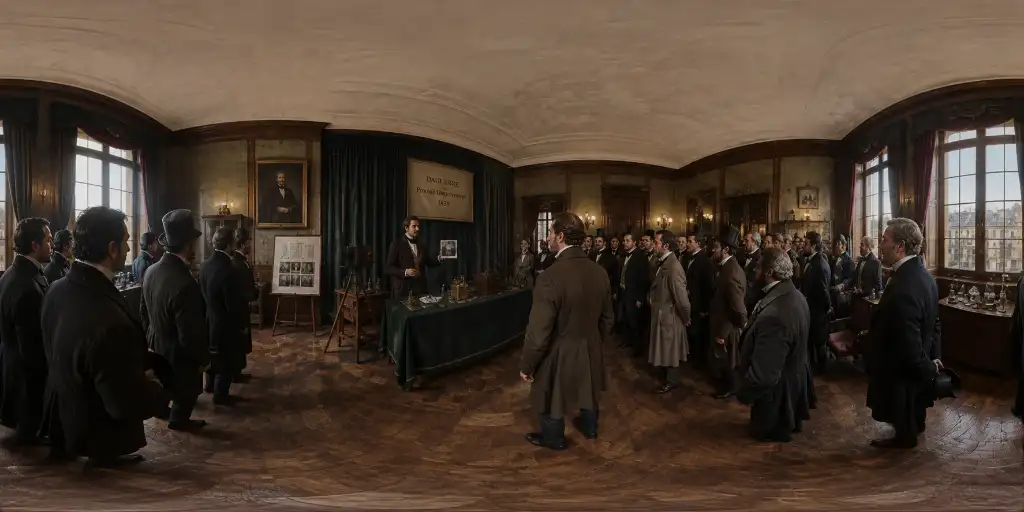
In Paris in 1839, in a dark room filled with chemicals and glass plates, Louis Daguerre was preparing to unveil his revolutionary discovery. Before him lay a metal plate coated with silver, which he carefully exposed to light and then treated with mercury vapors. After a few minutes, an image appeared on it—precise and detailed, unlike anything the world had seen before.
Daguerreotype, as Daguerre called his process, allowed moments to be captured with unprecedented precision. When presenting his invention, Daguerre showed photographs of Parisian streets that looked real, in a world where paintings and drawings had previously dominated. Although the process was complex and required long exposure, it marked a significant leap forward.
Daguerreotype opened new possibilities for science and art. People could, for the first time, preserve faithful images of their loved ones, cities, and events. Journalism changed as newspapers began to bring real images of the world. Although daguerreotype was later replaced by more advanced techniques, its impact on photography and society has endured to this day.
Where it happened
Coordinates: 48.8566, 2.3522 · View larger map
FAQ
In what year did Invention of Daguerreotype Photography happen?
It happened: 1839.
What was Invention of Daguerreotype Photography?
Introduced in 1839, the daguerreotype was the first widely successful photographic process and launched the age of photography.
Where can I try Invention of Daguerreotype Photography?
On HistoryGuesser — explore a 360° scene and guess where in the world and in what year it happened.
What you'll see here
In the game you stand right at this place in a 360° panorama and guess where and when the event happened.
View in 360° →